Tag: #2022

  • Success Stories – Team Nightwatch

    Success Stories – Team Nightwatch

    Paul Atkins from Team Nightwatch for Project Business Butler
    The Nightwatch team existed before GovHack. It was a group of five that went through uni together. Only Andrew was available for the GovHack weekend but it was a strong core.

    A data visualisation solution for small business to compare themselves against other businesses

    The challenge

    How can we help small business owners to easily compare how their business is tracking across a range of performance indicators compared to other similar businesses?

    The team chose this after looking at the available data. They found that they could find things like locations that might be good to open a new business because the area is not already saturated. Profit data was available to indicate good places for small businesses.

    The solution

    “We started building an actual API. Paul put about eight hours into it, before accepting that it just wasn’t going to get done.”

    Team mate Milan, an Excel genius, created amazing spatial maps. Andrew created all the imagery. “There’s no actual POC (proof of concept), it’s all mock”. User interfaces, that actually work, were built in Figma. 

    The team

    The Nightwatch team existed before GovHack. It was a group of five that went through uni together. Only Andrew was available for the GovHack weekend but it was a strong core. One of the uni team works for ABS and so was not eligible for GovHack. Milan is a product manager at Paul’s work.

    The weekend

    The team came up with the idea before the weekend started. On Friday they got the datasets and challenges and started reviewing them as suitable. 

    “We had about an hour of chat and thought – this looks cool – let’s do this!”

    Saturday started at about 9am but Milan had a childcare problem and wasn’t available until about 4pm. Andrew and Paul tried to make a proof of concept in React. “Totally wasted too much time on that”. At that point they switched to Figma to make a mockup. 

    On Sunday afternoon the slideshow video was started in a tiny corner of the hackerspace. 

    Advice to new competitors

    “I wouldn’t necessarily try to make an application that works – I would purely use Figma or Miro or Invision or one of those prototyping apps”.

    Figma lets you build a prototype and actually run it on your phone.

    “Choose a data set that you have an interest in, because if you’re interested in it, that’s where you’re going to find gold”.

    “It was a fun weekend. I really enjoyed talking to the other teams, the sponsors and mentors”. 

    GovHack gets real

    Paul said that just this morning he was working on a suite of apps called “Buttler Apps” and Business Butler is one of those. Eventually he and Andrew will release a commercial version.

    Story by Peter Marks

    Thank you Paul Atkins for participating in our Success Stories feature!


  • Success Stories – Team Jarvis

    Success Stories – Team Jarvis

    Mangesh’s Team was a team of four. Two were office mates  and the other was a friend so they knew each other from the “get go”.

    The last GovHack event was very smooth for Mangesh’s award winning team “Jarvis” but it wasn’t always like that in past years.

    The last GovHack event was very smooth for Mangesh’s award winning team “Jarvis” but it wasn’t always like that in past years. 

    This GovHack was his third year and the experience paid off.

    The team

    Mangesh’s Team was a team of four. Two were office mates  and the other was a friend so they knew each other from the “get go”.

    The team chose a state level challenge from the ACT that asked them to use public transport data to address pain points. In their analysis they found that in peak hours, busses are super loaded, but off peak they are not being used at all.

    The solution

    The solution they came up with was to create a dynamic pricing model that calculates a price based on distance, occupancy, and time of day. By using price signals, the system might encourage a passenger to defer their trip to get them out of the busy time. 

    The dynamic pricing information would feed into a passenger’s mobile app in real time so they could, for example, skip a bus and catch a cheaper fair just five minutes later.

    The team were all engineers and the solution was built using React and Spring boot (a micro services layer) running on Amazon’s cloud.

    The Competition Weekend

    Friday was “overall ideation”, the team all agreed with the project and a system architecture was sketched out on the white board. 

    Saturday’s focus was on getting the proof of concept UI design out. 

    Sunday was fine tuning of the design, mockups, proof of concept and preparing for the recording of the video. 

    Advice for first timers

    Tips for new GovHackers?

    The first year Mangesh participated in GovHack he didn’t join the team until the Saturday night and, looking back, he was super confused about how it should work. 

    His friend rang and said “hey, there’s something cool, why don’t you come over?”.

    That year the team couldn’t even finish the problem statement by the end of Sunday. “It was a bit of an experience”.

    Mangesh’s advice is “Grouping on Friday and zeroing on the challenge is super critical to achieve good outcome on Saturday and Sunday. It’s also very important to have clear roles defined to work out the solution in 2 days. Building the mock-ups / Designs and Scripts for video presentations along the way just helps to not spend a lot of time on presenting the idea in 2:30 mins”.

    The experience of doing a hackathon helps people in their work as they get to quickly look at a problem and prototype a possible solution in a short timeframe.


    Story by Peter Marks

    Thank you Mangesh Gopale for participating in our Success Stories feature!


  • Success Stories – Franklin’s GovHack Story

    Success Stories – Franklin’s GovHack Story

    Franklin and the team for the project Lynk
    Franklin and the team for the project lynk

    Lynk is an app that connects the youth to their local communities via their school, and helps them learn crucial life skills that they don’t teach you at school!

    The problem to fix

    After kids finish high school, some of them don’t know what to do, but they have major decisions to make that will affect their future. There are a lot of essential life skills that they might need and weren’t given enough opportunity to master them before starting adulthood. These skills include cooking, taxes, and resume making. 

    While at school, you’re learning but then, suddenly, you must decide on your future. We are not taught to make big decisions at school.

    What the team built

    Lynk is an app that connects the youth to their local communities via their school, and helps them learn crucial life skills that they don’t teach you at school! The app gathers events and shares them with users near to that location. The app can also help with other skills for the newly independent person – even cooking! 

    With this product, we are expecting people to be able to get more opportunities to gain skills that are useful for them in the future. The app was built with Flutter and is multi-platform including Android, iOS and even Linux.

    Team roles

    The team formed on a networking event before the competition although two of them knew each other already.

    Dominic worked on gathering data. Jerry and Zachary did the app programming. Franklin was fresh from high school and learned a lot from the team.

    Competition weekend

    Friday night was spent looking at the challenges to find the ones of most interest to the team. The time was spent problem solving and planning but also moved into design and a little coding. By the end of Friday the team knew what they would do over the weekend.

    Saturday was not high pressure, they had an easy-going approach. The team finished most of the coding part and did most of the design, including the descriptions, UI design, app logo and app design. The day went well and finished at about 8pm.

    On Sunday the app was mostly finished and the team started the video editing. Everything was finished about two hours before the deadline just in case something went wrong. 

    GovHack benefits

    Franklin met a lot of talented people in multiple areas. “It makes me motivated and interested in new stuff.”

    Team Lynk on Hackerspace


    Story by Peter Marks

    Thank you Franklin Huang for participating in our Success Stories feature!


  • Success Stories – Rita Arrigo’s GovHack Story

    Success Stories – Rita Arrigo’s GovHack Story

    Rita Arrigo's team "AuZero" were prize winners in the 2022 GovHack in Victoria.
    Rita Arrigo’s team “AuZero” were prize winners in the 2022 GovHack in Victoria.

    Rita Arrigo’s team “AuZero” were prize winners in the 2022 GovHack in Victoria. They wanted to generate clean energy by using public spaces to host solar panels, kinetic paving, wind turbines and more.

    The problem

    Wanted to leverage public spaces to generate clean energy solutions like solar panels, kinetic bikes, kinetic paving blocks, wind turbines. All these sources will generate clean energy which can be used to charge EVs, light up public spaces and power public utilities.

    Also by hydrophonic framing, we can sequestrate Co2 emissions.

    Over a period over 25 years we can save 6.1million ton CO2 using these practices.

    The solution

    The team used AI to generate understanding of all the different public spaces that exist in Australia to put together a portfolio of energy generating biophylic products that would reduce the carbon footprint in those areas. 

    (Biophylic design is an approach to design that uses the natural environment in building). 

    An example used by the team was a bus stop that is covered in plants. The bus stop would do soil sequestation while keeping users cool, rather than being a tin shed as we often see today.

    Data was pulled in from the various sources linked by GovHack and imported in to a DataBricks cloud data warehouse resulting in a prediction model to estimate the business case of different options.

    The team

    The team met at GovHack on the Friday night. “It was really exciting as we just connected and got on really well”. Rita was there with her husband who is a web developer who wanted to find out more about databases. Rita wanted to make connections with people from Government. They sat next to others who joined the team. They talked about what they were interested in and the combination was good.

    Rita brought sales skills, Aman was good with data manipulation. Aman’s wife was brought in to help with the video but it turned out she was a mobile developer and was able to build an app. 

    “It became a family affair”.

    “The venue was beautiful, we were very comfortable, it made it feel like fun rather than work”.

    Timing

    Friday night was finding the team and listening to presentations on the data and challenges. 

    Saturday started early, at about 10am, it was a rainy day – really boring – a perfect day for hacking!

    It was a lovely atmosphere, people had their kids there. Saturday was devoted to data transformation.

    On Sunday the app was created and the video was produced. 

    The approach to the video was to do screen recordings. Rita is very good at telling stories.

    Lessons from GovHack

    Networking at a hackathon is a great opportunity combined with “getting your hands dirty” by being able to think about a project in a way that’s real. Rita had not been able to do her own machine learning project leading to predictions so found it great to learn to talk to a data scientist about a problem.

    Advice for first timers

    “Bring your A game, your open mind, a computer that’s not locked down, and get ready to meet new people and think about things in a different way”.

    National AI Centre at CSIRO

    Rita now works at the National AI centre which is hosted at CSIRO. It is there to help “uplift” AI capability in Australia by educating the community, building a directory of AI companies, and promoting responsible AI practice.

    AI is much more transformative than digital transformation and it does need executives to be involved. “We could be in a Napster moment, with ChatGPT”.

    GovHack teaches us how to tell a story about what a technology does. “GovHack is a fantastic opportunity, that you don’t get at work, to think outside the box, work with new people, and solve challenges that you’re passionate about”.


    Story by Peter Marks

    Thank you Rita Arrigo for participating in our Success Stories feature!


  • Success Stories – Alohomora Algorithm

    Success Stories – Alohomora Algorithm

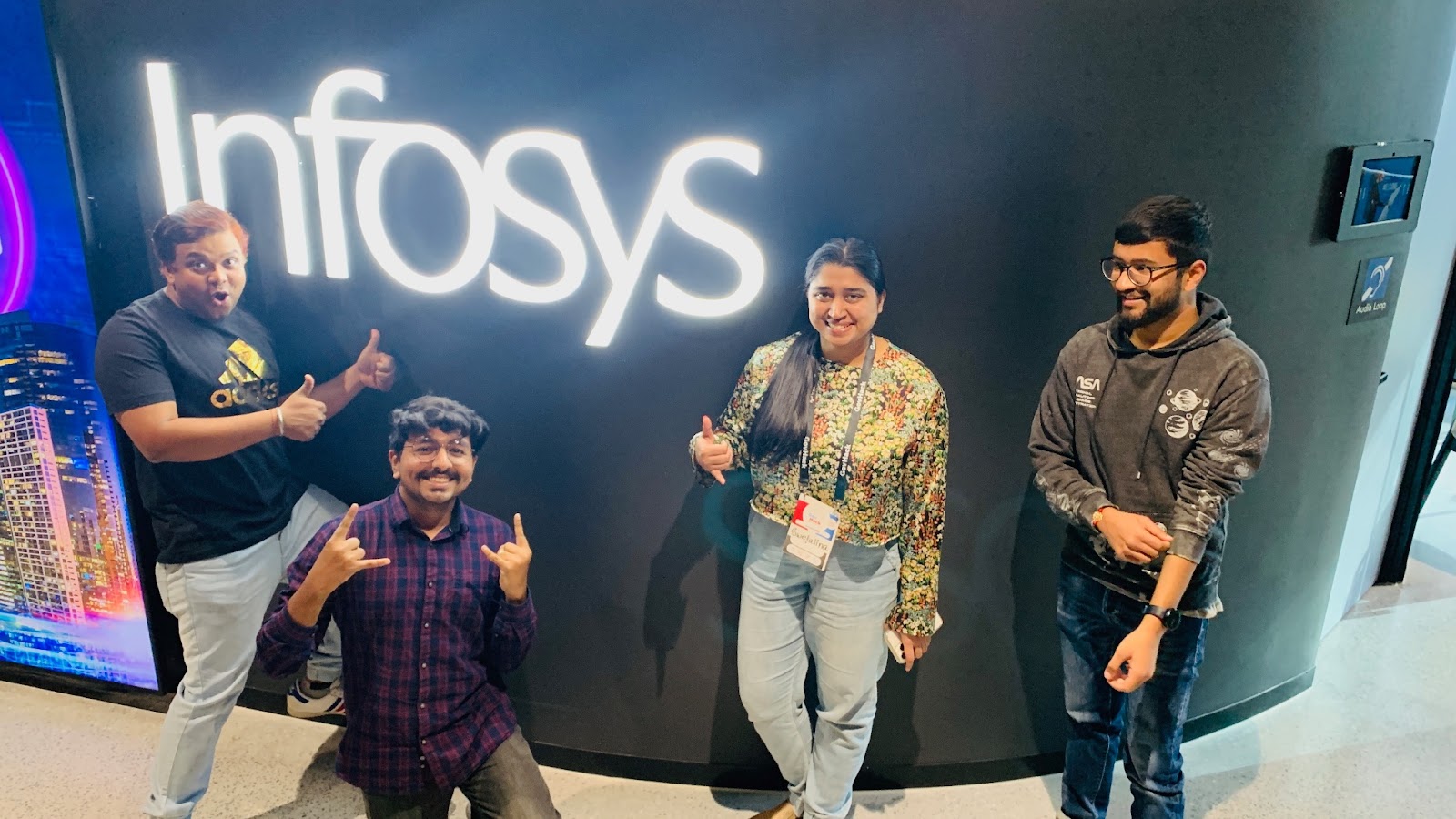
    Alohomora Algorithm Team Photo
    The ‘Alohomora Algorithm’ team members at the infosys location in 2022

    The Alohomora Algorithm team has been entering GovHack since 2018, and their team name is based on a Harry Potter spell that unlocks doors, in this case unlocking potential.

    The challenge

    The problem to fix came from VicGov which was to use data better but in particular the issue of incomplete or incorrect addresses. An example might be that a single address on a corner has two entries. Sometimes a street name is given but it’s in a different suburb. Accidents at remote locations are hard for emergency services to pinpoint. The road network is dynamic, over time with new buildings going up but also in real time where roadworks or accidents might change traffic flow.

    The approach

    The team broke the solution into three parts: compare, predict and synergise. Compare would look at multiple candidate addresses to find the most likely match, landmarks are then used to narrow down the most likely address, “predict” uses a prediction model to decide on the most likely real address.

    What was built

    Rather than building a working model, the team came up with multiple use-cases with solution approaches. 

    The team used Canva which is a collaboration and design tool. It can create wireframes, customer journeys, info-graphics, videos and presentations and as Anikesh has a full license for his work they were able to use that. 

    Team skills

    Anikesh did mostly UX design, presentation and brainstorming. 

    Swetalina and Saket are developers so they proposed the logic of the solutions and how they might be implemented. 

    Rup is a University student doing his bachelors degree so GovHack was his first exposure to real time problem solving.  

    Data

    The team created their own database to bring together unique address IDs. In particular the latitude and longitude were used as well as the Google “Plus Code” which is a short location identifier that can be used for locations without an address. They look like “JJXX+HR8, Seattle”.

    The hackathon weekend

    Friday night was where the team came together and looked at the just released problem statements. In the case of team Alohomora Algorithm they were all housemates but others might find their teams on the night. A challenge relating to linking up data relating to addresses was chosen and then they looked for another challenge that could be solved with the same solution. The team closed for the night by 10pm.

    Saturday began by picking the main problem to solve. By midday the team had to register the problem they’re working on. At the end of the day, the team was able to register for additional challenges. By the end of Saturday the team had the “why” and a high level “how”. The team took advantage of mentors who were available to help. They gave guidance about the approach and suggested other things the team hadn’t thought of. 

    On Sunday morning the team put everything together in diagrams and solution flows. Work on the video was started on Sunday morning but Anikesh is aware from experience that the video can be the hardest part of the work. Many teams start on the video on Saturday. It’s a good idea to split the team to have some working on the solution and others just working on the video.

    “There was a lot of time pressure”.

    Advice to first timers

    “Think about the problem as much as you can” on Friday night.

    Choose which problem you want to solve and why.

    Mingle with people if you don’t have a team, but do network even if you do have a team.

    “If you want to win GovHack – if you know the why, then 50% of the job is done”.

    Lessons from participating in GovHack

    Learning how to come up with a problem statement under time pressure.

    Choosing an approach to solving a problem.

    Anikesh finds that in his actual job finding the “why” is critical and GovHack is a great training ground.

    “GovHack is all about fun” Some people come to it looking for a job and while that may happen don’t get hung up on that too much. 

    “Network as much as you can – it’s not about your team, it’s about everyone”. “It’s a small world, you’re going to cross paths with these people in the future”.


    Story by Peter Marks

    Thank you Anikesh Sasmal for participating in our Success Stories feature!